The importance of the fan, filter and housing of an air purifier!
Aug 15, 2021
For an air purifier, it essentially uses a high-speed fan to suck the polluted air into the air inlet, and then make it fully contact with the high-efficiency filter material inside the machine, and then release the clean air from the air outlet after purification. go out. Although this seems quite simple, the fan, filter and casing greatly affect the overall function of the air purifier. For example, the fan of an air purifier determines the purification speed and noise level, the filter determines the purification effect and service life, and the shell determines the aesthetics and interactive experience. The following editor will give you a simple science popularization of the fan, filter and casing to help you understand the air purifier in depth.
Fan, filter and housing
1. Fan
Let's start with the fan. Air flow requires power, and the power of the air purifier comes from the fan. Assuming that the house is 110 square meters and 2 meters high, there are 308 cubic meters of air to be purified. If there is not a large enough fan, the 308 cubic meters of air has not yet been purified, and fresh polluted air will continue to flow in. Therefore, there are relevant regulations on the air volume of the air purifier, which requires that the indoor air can be filtered more than five times an hour to meet the standard. However, such a large air volume inevitably requires the fan to rotate at a high speed, and noise problems are inevitable. Home air purifiers are very sensitive to noise because they are mostly used in daily routines. This puts forward extremely high requirements on the technology of the fan. It needs to be large enough, high in stability, and at the same time to ensure that it is quiet enough under high-speed operation.
2. Filter
Next, let's talk about the HEPA filter, because all passive air purifiers use HEPA as the main filter material. The main materials of HEPA include polypropylene, polyester resin, ultra-fine glass fiber, etc., using offset paper or even aluminum alloy for fixing. The industry generally divides HEPA filter media into three levels, E-level, H-level and U-level. In the civilian field, H-level is usually adopted, among which the efficiency of the H13 and H14 standards for MPPS has reached 99.75 and 99.975 respectively. The higher the standard, the more expensive the filter, usually H10 is used as the standard for mid-range air purifier filters, and H12 is the standard for high-end air purifier filters.
3. Shell
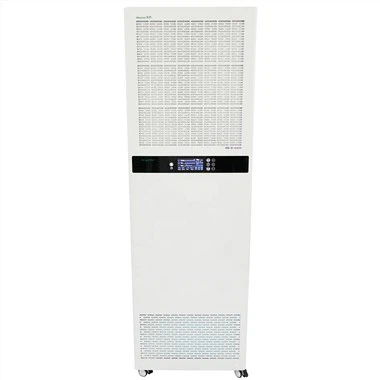
Finally, let's talk about the housing of the air purifier. At present, the mainstream brands on the market mostly use engineering plastics as the main material of the shell, and some manufacturers use all-metal shells to make the products look more durable. As the face value of an air purifier, the shell of course most directly reflects the level of industrial design. As a container for the fan and the filter element, the primary function of the housing is airtightness, which aims to avoid short-circuiting of the air during the flow. Secondly, the layout of the fan and filter element in the housing is also very particular. This layout must not only conform to the principles of aerodynamics, so that the air is unimpeded, but also need to extend the air travel path as much as possible to maximize the purification effect. It can be called a good shell if the two are perfect. In addition, the shell is also a stage for designers to show the humanity of their works. In addition to basic controls such as adjusting the wind speed and turning the machine on and off, air quality testing and filter life reminders have gradually become standard equipment for mainstream brands. With the advent of the Internet of Things era, intelligent interactive ports that can access the Internet will also become the trend of the future.