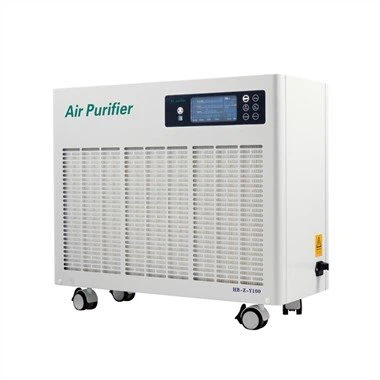
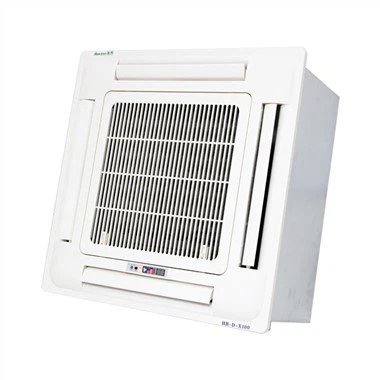
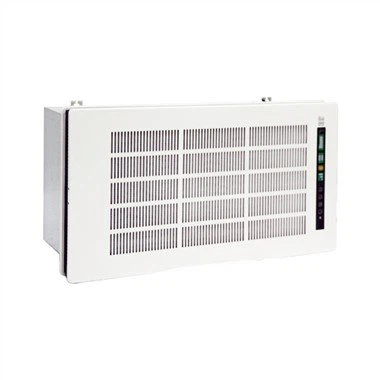
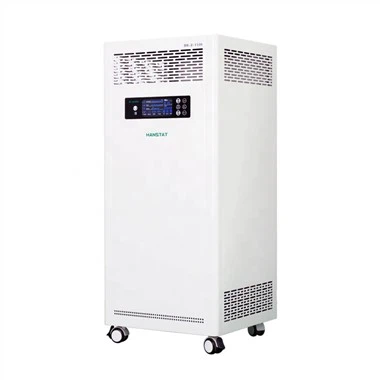
Keeping these three points in mind, you can easily buy an air purifier that suits you.
Aug 05, 2021
I believe everyone knows that there are hundreds of air purifier brands on the market, and every air purifier manufacturer has multiple air purifier models. If consumers know less about air purifiers, they may not know How to choose an air purifier that suits you. And ordinary consumers may not know that when buying an air purifier, you must consider not only the air purification effect, but also whether there will be "secondary pollution", voice or other energy-saving issues. The following editor will give you a brief chat from three aspects, so that everyone has a basic understanding before buying an air purifier.
1. Purification principles and technical characteristics of air purifiers
Most of the air purifiers currently on the market use mechanical filtration and electrostatic adsorption to clean indoor air. For example, the filtration method of using a high-performance fan to drive the air through a high-efficiency particle filter to remove pollutants in the air is a relatively common mechanical filtration method. Its characteristic is that the air can pass but the fine particles cannot pass. The filter that meets the HEPA (high efficiency filtration) standard can quickly and effectively remove 0.1 micron particles. A filter with too high density will limit the air flow through, making the machine need a very powerful fan, which will generate more energy consumption and make more noise; while a filter with too low density is blocking particulate matter The performance will drop again. Filter consumables need to be replaced regularly to ensure purification efficiency and avoid secondary pollution.
Electrostatic adsorption filtration is to attach particles and other pollutants with positive or negative charges, and then adsorb these particulate pollutants on the collection plate carrying the opposite charge. The advantage of electrostatic dust removal technology is that it can make the air purifier run with low noise and low energy consumption. However, the effect of electrostatic adsorption on capturing larger and heavier particles will gradually decrease, and air purifiers with pure electrostatic adsorption technology usually release ozone. If the concentration of ozone is too high, it will combine with other impurities in the air to produce a chemical reaction. This will cause great harm to human health. Relevant departments have stipulated that when the ozone concentration exceeds 0.16mg per cubic meter, air pollution is constituted; in the workplace, when the ozone concentration exceeds 0.2mg per cubic meter, it constitutes pollution. But in the home environment of ordinary people, it is difficult to understand and test the real-time ozone concentration. Therefore, for the air purifier with electrostatic adsorption and filtration function, it is very likely that the ozone concentration will be too high in the actual use of family life, which has certain risks.
The ideal air purifier should be a combination of ion generator and high-efficiency particle filter, so as to achieve a better purification effect. Unlike electrostatic precipitator technology, the ion generator requires a very small voltage so that it does not cause ozone risk, and the particles it releases can charge the air in contact with it, and the charged particles will be more likely to be filtered by the high-efficiency particle filter. Capture, and finally achieve high-efficiency purification efficiency.
2. Domestic and international third-party certification
There are currently two domestic and foreign standards. One is the new international air purifier announced in September 2015, which clarifies the four core indicators that affect the purification effect of air purifiers, namely CADR (clean air volume), CCM (cumulative Purification capacity), energy efficiency rating and noise standards; there is also the American Association (AHAM), which is currently the most authoritative third-party independent testing organization for testing and assessing the performance of air purifiers. Generally, air purifiers certified by it must After rigorous testing. Therefore, if consumers have higher requirements for indoor air quality, they can choose GB/T, AHAM and other certified air purifiers that have obtained domestic or international certification.
3. Air purification area
An air purifier is similar to an air conditioner. Its purification effect has a certain applicable area, which is larger than the purification area of an air purifier, so its purification effect must be greatly affected. For consumers, it is very important to choose an air purifier with a purifying area that matches the area of the room. Because high-efficiency purification efficiency requires a strong circulating air volume to drive the filtering of indoor air, the more the air passes through the filter per hour, the higher the efficiency of the air purifier to purify the air. According to international standards, the air purifier must filter the air in the room more than five times per hour to qualify. From this, it can be concluded that for a room of 30 square meters and a room with a floor height of 2.5 meters, 30 square meters * 2.5 meters * 5 times = 375 cubic meters per hour, and at least one air volume of 375 cubic meters should be selected. /Hour air purifier.