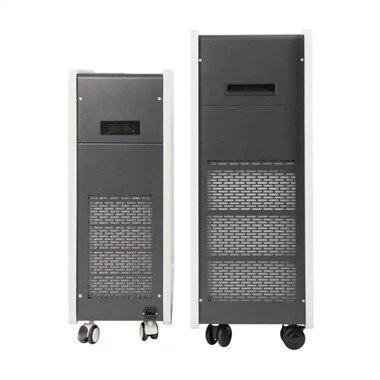
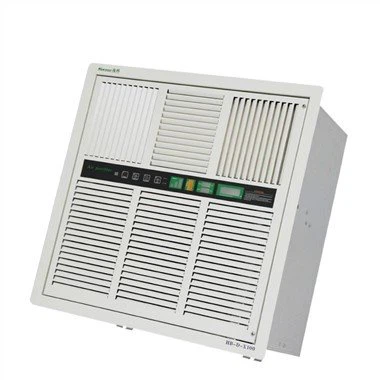
How does an air purifier purify the air? Come here and take you to find out!
Aug 01, 2021
Because of the needs of air purification and air disinfection, air purifiers have entered more and more fields of vision, but not many people know about air purifiers, especially their purification principles. Today, the editor will sort out the purification principles of air purifiers for everyone, and help you simple science, so that everyone can roughly understand the purification principles of air purifiers and understand air purifiers better.
1. Passive purification
The purification methods of air purifiers are generally divided into active and passive purification, and the more common air purifiers in the market are passive adsorption filtration purification methods. Its basic principle is actually relatively simple, which is to use a blower to suck air, and then filter out air pollutants through layers of precision filters, and finally get clean air. To understand the principle of air purification, we must first know what pollutants are in the air.
Common air pollutants in the air are PM2.5 and PM10. How do we understand these two values? PM is the abbreviation of English Particulate Matter (Particulate Matter). The 2.5 and 10 behind PM are the numerical values used to express the size of particles. Generally expressed in microns, 1 micron = one millionth of a meter. The larger the value, the larger the diameter of the particle. big. Particles with a diameter less than or equal to 10 microns are called PM10, and particles with a diameter of 2.5 microns and equal to 2.5 microns are called PM10. They can all enter the upper respiratory tract through the nostrils. Compared with PM10, PM2.5 has a smaller particle size, larger specific surface area, strong activity, and is more likely to be accompanied by toxic and harmful substances (such as heavy metals, microorganisms, etc.), and the residence time in the atmosphere Long and long conveying distance. At the same time, it is more likely to stay in the terminal bronchioles and alveoli, so M2.5 has a greater impact on health than PM10.
For air purifiers, the more difficult part to filter is particles with a diameter of 0.1 to 0.3 microns. For this part of the particles, a filter with a filtering effect of 99% can be called a HEPA (high efficiency) filter. It is made of very fine fibers intertwined with a strong ability to capture fine particles, with a small pore size and a large adsorption capacity. , High purification efficiency. Its material composition is generally PP (polypropylene) high-efficiency filter paper, PET filter paper, PP and PET composite high-efficiency filter paper, and glass fiber high-efficiency filter paper. The air is filtered through multi-layer stacking, and because the materials are all paper, they generally cannot be washed with water. . The HEPA filter is the core of the air purifier, but its cost is higher, so it is necessary to add a lower cost filter before it to filter the air in two layers. Among these filters, bacteria and viruses are relatively special. In order to avoid the breeding of bacteria and viruses, the air purifier also needs to have the ability to sterilize. At present, the more commonly used UV sterilization technology.
In addition to these particulate matter, the other part that needs to be filtered is harmful gases, such as formaldehyde, benzene and other gases. Their molecular diameter is between 0.4 and 0.6 nanometers (1 micron is equal to 1000 nanometers). To filter them, activated carbon or Photocatalyst method. Since the diameter of oxygen molecules and nitrogen molecules is about 0.3 nanometers or less, they can pass through the pores of activated carbon through which harmful gases cannot pass, and finally achieve a filtering effect. The principle of photocatalyst is that if materials such as titanium dioxide are irradiated with ultraviolet light, water or oxygen near these materials will be catalyzed into strong oxidizing molecules such as hydroxyl radicals and active oxygen. They can oxidize harmful gases such as formaldehyde into water, and can destroy the proteins in bacteria and viruses. Because titanium dioxide is used as a catalyst in this process, there is almost no loss, so photocatalyst technology has become a more commonly used air purification technology in current air purifiers.
2. Active purification
In addition to passive purification, there is also an active air purifier. The fundamental difference between the principle of active air purification and the principle of passive air purification is that active air purifiers get rid of the restrictions of fans and filters, instead of passively waiting for indoor air to be drawn into the purifier for filtering and purifying, and then passing through. The fan discharges, but effectively and actively releases the purification and sterilization factor into the air. Through the characteristics of air diffusion, it reaches all corners of the room to purify the air without dead ends. In the active purification technology, there are mainly negative oxygen ions and the use of ozone as a purification factor to treat air. Compared with the passive purification mentioned above, these two are less used in the current air purifiers on the market, so they will not be expanded.